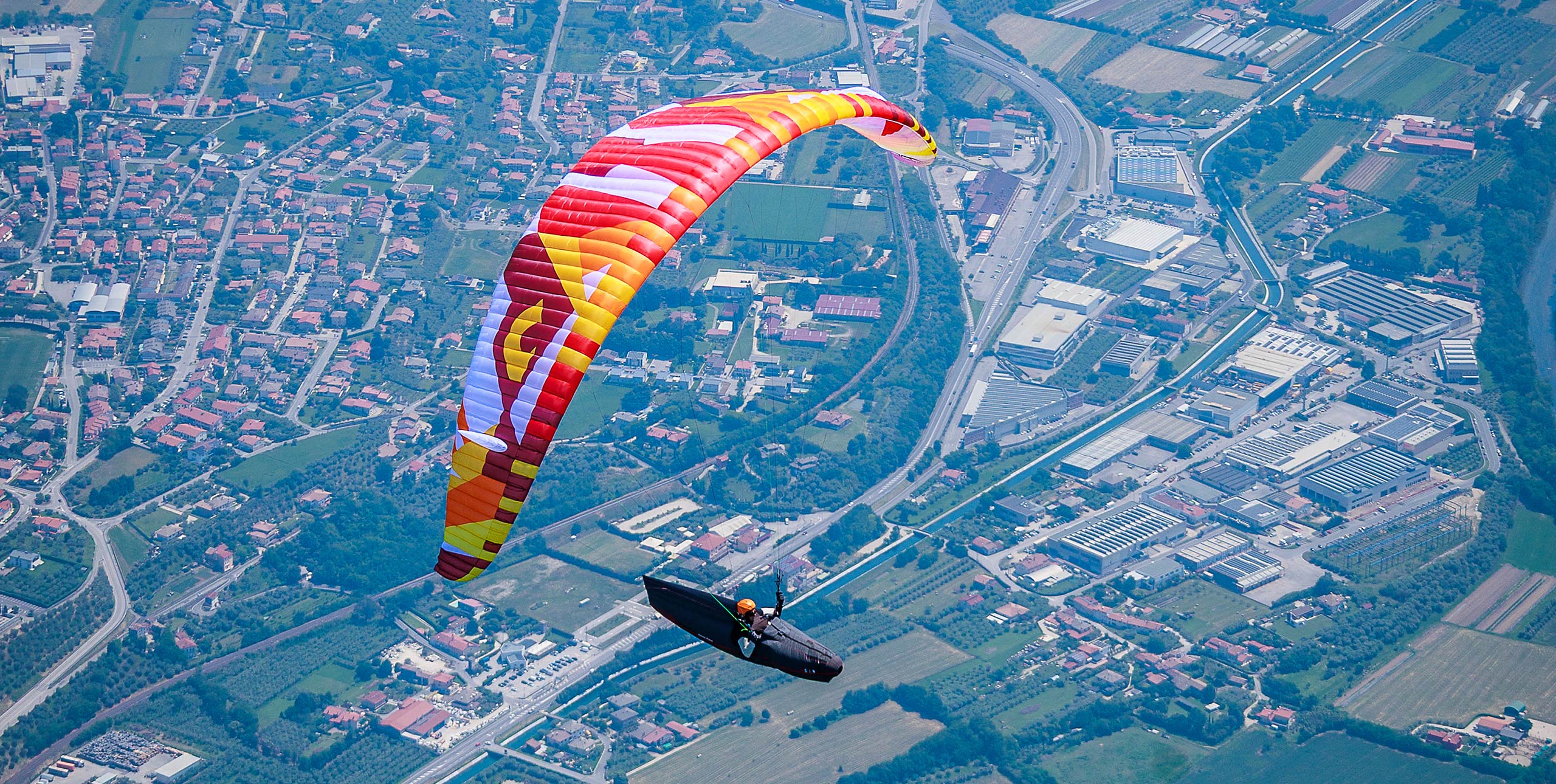
Gin Gliders… paragliding in technicolour in 2010, a decade after this interview was published
Paraglider designer Gin Seok Song caused a splash in the paragliding world when he quit Edel and formed his own company. Here he talks to Hugh Miller about why. First published in 1999
How did you get involved with paragliding design?
I studied Naval Architecture at University so my first designs were racing dinghies. I learnt to hang glide in 1976, and it became my main focus. While competing in hang gliding competitions in Europe, I came into contact with paragliders. I made one just for fun, but it flew rather well. That inspired me to come back to Korea and start the Airman company in 1987. Our first glider was the RC, followed by the XC.
After such a long and fruitful time with the world’s largest manufacturer, why did you leave Edel?
I thought of Edel like my house, but as time went by, I was made to feel like a visitor who had over-stayed his welcome. I did the polite thing.
What are your philosophies behind your new company?
We are in this business for the love of the sport and the people involved in it. Human relations are more important than anything else. We believe in promoting the sport as a whole. Internationally, we support competitions, while in Korea, I am on the road every weekend running seminars and courses.
Do you have any financial backers?
Behind Gin Gliders is Sungdo, a group of eight companies which includes one of Korea’s top clothing manufacturers. The chairman, Mr Choi is a keen paraglider pilot.
You’ve succeeded in drawing in a lot of top pilots into your team. Is that the result of big cash payments?
You should ask the pilots why they joined! I’ve been an international competitor in both HG and PG for a long time, so most of the pilots know me and they know where I’m coming from. It’s very important for a comp pilot to have a good relationship with the designer. But I think most of all, they like the glider!
How are the gliders designed and tested?
Glider design is still very much an art, despite today’s technology. A designer creates his own mental theory based on experience. We have a mountain behind the factory which offers a variety of conditions, and a boat for over water testing. Sei Young and I test the gliders, and Hans Bollinger and Kaoru Ogisawa complete the team. I don’t have too many test pilots as it spoils the feel of the glider.
We don’t trim (ie modify the airfoil by altering line lengths etc) gliders much these days as it’s inefficient. Changes are made on the computer, and we produce a new prototype with the new airfoil. For competition gliders, feedback from the pilots is very important. We concentrate more on a glider’s feel than on technical data.
You’re an outspoken critic of the Serial Class concept (the push to ban protos from competitions). Why?
I’m not against the concept itself, but there are issues about its current form which haven’t been raised. I feel that the manufacturers have not expressed their viewpoint.
First of all, it was supposed to improve the safety of competition pilots in the PWC and similar events. In any case, I don’t think manufacturers are designing ever more radical wings that pilots are risking their lives to fly. Each of the top pilots has a mental picture of the degree of security they want in a glider. The manufacturer designs a glider that satisfies these requirements.
If I make a wing that is too radical, no one wants to fly it. Or even worse, pilots do fly it and have accidents. Most of the top pilots are still flying open class this season, so obviously they don’t think that the current models are too dangerous. The prime cause of accidents is still the weather, and the organisation committees and task setters have a great responsibility here.
Secondly, the manufacturers may not be helped by serial class. The current serial class is in danger of pushing glider development away from what the market wants. The future of the sport depends on new pilots and the weekend flyer. We have reached a stage where a class 1/2 or 2 glider has enough performance for most pilots. Already many pilots who don’t compete are moving down to this class of glider.
If I want to win serial class, I can make a tuned down competition glider that still gets DHV 2/3 or Acpul Performance. If the weekend pilots fly this type of wing next year, we will see accidents. As a manufacturer, I’ve spent time and money developing two models that few people can fly, one for open class and one for serial class. It would be better for us and the sport to direct the development into the beginner and intermediate class.
Many of our development concepts come from testing in open class competition. Pilots see a company’s image by the competition results, but they buy a different model themselves.
I think that having two separate classes of competition is not the way to go. Competition is competition, but if we do need more controls, we should be thinking about making them in open class.